Partner 2 Coordinator
Research profile
60+
scientific articles
29
H-index
2100+
citations in Scopus
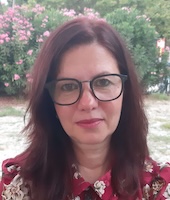
Luminița Camelia Andronic is a Professor in the Department of Product Design, Mechatronics and Environment at Transilvania University of Brașov (UNITBV). Her research connects photocatalysis, advanced materials and environmental engineering, developing technologies for water and air decontamination and the sustainable production of green fuels and chemicals.
Her expertise encompasses semiconductor photocatalysts, nanostructured carbon materials and integrated processes for pollutant removal and industrial waste conversion. Her research interests also include nature-based solutions for urban infrastructure, addressing water consumption and soil and air pollution. These complementary directions connect environmental protection with resource valorisation, circular economy and urban sustainability.
Research and academic background
She graduated from Babeș-Bolyai University in Cluj-Napoca in 1995 with a degree in Chemistry and Physics. She subsequently completed a master’s programme in Applied Chemistry in Environment and Industry at Transilvania University of Brașov in 2008.
In 2010, she obtained her doctorate in Materials Science and Engineering at UNITBV, followed by postdoctoral research during 2010–2013. Her doctoral and postdoctoral work addressed semiconductor and ceramic materials, synthesis and deposition techniques, materials characterisation and photocatalytic processes for wastewater treatment.
In 2018, she obtained her habilitation in Environmental Engineering at the Technical University of Cluj-Napoca. Since 2020, she has coordinated the Environmental Engineering Doctoral Programme at UNITBV.
Her main reseach areas include:
- Photocatalysis and advanced oxidation: light-driven degradation of organic pollutants, including pharmaceuticals, pesticides and dyes.
- Semiconductor nanomaterials and heterostructures: development of titanium dioxide, black TiO₂, metal oxides, sulfides and carbon-containing composites.
- Integrated wastewater treatment: combining adsorption and photocatalysis to address complex pollutant mixtures.
- Materials synthesis and characterisation: preparation of powders, coatings and thin films, and investigation of their structural, surface and optical properties.
- Environmental safety and sustainable applications: aquatic toxicity of photocatalytic nanoparticles, resource recovery and nature-based approaches to environmental management.
- Photocatalysis
- Nano-structured materials
- Green fuels
- Water and ai treatment
- Waste valorisation
- Nature-based solutions
Leading research and collaboration
Her academic career at Transilvania University of Brașov began in 2003. She progressed through appointments as Assistant Professor, Lecturer and Associate Professor before becoming a Professor in 2019. Her teaching covers chemistry, wastewater treatment, integrated technologies for wastewater treatment and soil decontamination, life cycle assessment and project management.
Her project leadership includes the ERA-NET projects TESTIMONIES, investigating transition metal oxyhydride nanomaterials, and 3D-PHOTOCAT, developing multifunctional three-dimensional photocatalytic systems for sustainable environmental technologies. Her recent project portfolio also includes NATURE-DEMO, addressing nature-based solutions for climate-resilient infrastructure, and INNO-AGRIHYDRO, connecting photocatalytic decontamination with sustainable hydroponic agriculture.
Her scientific work examines how material composition, surface properties and light absorption influence pollutant degradation. Her publications include research on solar wastewater treatment, photocatalytic removal of pharmaceuticals and pesticides, combined adsorption–photocatalysis processes, and the aquatic toxicity of nanoparticles.
Training the next generation of researchers
As a doctoral supervisor and Coordinator of UNITBV’s Environmental Engineering Doctoral Programme, she supports research at the interface of materials science, environmental chemistry and treatment process engineering. Her academic work includes supervising student research, guiding graduation theses and mentoring practical and experimental activities.
Her teaching connects fundamental chemistry with applied environmental technologies and their assessment. Courses in wastewater treatment, life cycle assessment and project management help students develop the technical and organisational skills needed to investigate environmental problems and evaluate potential solutions.
Her wider academic responsibilities include membership of the Environmental Engineering commission of Romania’s National Council for the Certification of University Titles, Diplomas and Certificates (CNATDCU), alongside participation in national and international research evaluation.
Within CERSUS, her experience supports the training of young researchers in materials synthesis and characterisation, photocatalytic experimentation and wastewater analysis. Collaboration across the consortium provides opportunities to connect these skills with ecotoxicology, resource recovery and sustainability assessment, strengthening interdisciplinary research capacity..
Role in CERSUS
As leader of the UNITBV partner team and WP3, Luminița Andronic coordinates research on advanced and emerging wastewater treatment processes for circular water management, nutrient recovery and energy recovery.
Her role connects the development of innovative materials with their integration into treatment and resource recovery processes. Working with the consortium partners, she supports the evaluation of materials developed within WP2 and their application to the removal of priority and emerging pollutants, linking material properties with process performance and environmental safety.
The WP3 programme encompasses integrated pollutant degradation, nutrient and metal recovery, photoelectrochemical hydrogen production, and the conversion of biogas and carbon dioxide into useful fuels and chemicals. Her expertise in photocatalysis and semiconductor materials contributes particularly to the development of light-driven treatment and conversion systems.
Through this coordination, she helps connect materials research, water treatment and resource valorisation, supporting the project’s transition from individual laboratory findings towards integrated solutions for the circular bioeconomy.
<top><go to management team><go to P3-UNITBV>