Partner 1 (UPT) Coordinator
Research profile
138+
scientific articles
26
H-index
2100+
citations in Scopus
CV (English)
Scopus
Web of Science
Research Gate
Google Scholar
ORCID: 0000-0003-1285-6634
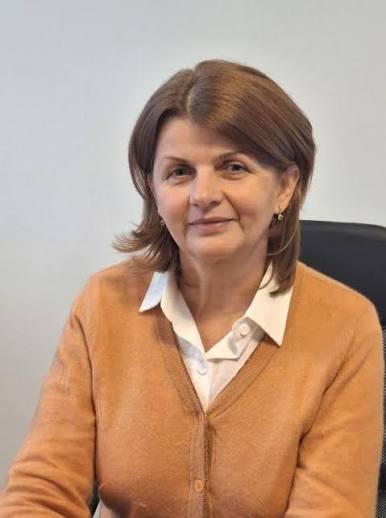
Florica Manea is a Professor at the Faculty of Industrial Chemistry and Environmental Engineering of Politehnica University Timișoara (UPT) and Director of its Environmental Science and Engineering Research Centre. Her research combines electrochemistry, advanced materials and environmental engineering to develop technologies for water treatment and water quality monitoring.
Her expertise is in pollutant removal, analytical control, integrating electrochemical and photocatalytic processes with sensors capable of detecting contaminants in water. Through interdisciplinary research and collaboration with academic and industrial partners, she contributes to the development of treatment systems that support pollution prevention, water reuse and sustainable resource management.
Research and academic background
She graduated from Politehnica University Timișoara in 1995 with a degree in Chemical Engineering, specialising in Inorganic Substances Technology. In 1996, she completed a master’s programme in Non-polluting Process Technologies at the same university. She obtained her PhD in Chemistry from the West University of Timișoara in 2005, with training encompassing electrochemistry and environmental science and engineering. In 2015, she obtained her habilitation in Environmental Engineering at “Gheorghe Asachi” Technical University of Iași, qualifying her to supervise doctoral research.
Her international experience includes specialist research training at Delft University of Technology, the Netherlands, during 2001–2004, and visiting professor appointments at Delft University of Technology, the University of Sassari, Italy, and the University of Namangan, Uzbekistan.
Her main research areas include:
- Advanced water and wastewater treatment: development and integration of processes for pollutant removal and water reuse.
- Electrochemical treatment technologies: electrooxidation and electroflotocoagulation for water pollution control.
- Electrochemical sensors: amperometric and voltammetric detection for environmental monitoring, with additional applications in health, pharmaceutical and food analysis.
- Advanced oxidation and photocatalysis: combined treatment approaches for the degradation of persistent contaminants.
- Advanced materials for environmental applications: synthesis, characterisation and application of functional materials in treatment systems and sensing platforms.
- Electrochemistry
- Photocatalysis
- Electrochemical sensors
- Water treatment
- Advanced oxidation
- Functional materials
Leading research and collaboration
Her institutional leadership has included serving as Head of the Department of Applied Chemistry and Engineering of Inorganic Compounds and the Environment during 2016–2020 and Interim Dean of the Faculty of Industrial Chemistry and Environmental Engineering in 2020. Since 2021, she has directed UPT’s Environmental Science and Engineering Research Centre.
She has led and coordinated research addressing electrochemical water treatment, photocatalytic filtration, environmental sensors and integrated water management. Examples include a three-dimensional electrochemical filtration system for water containing cytostatic compounds, photocatalytically assisted filtration using modified activated carbon and zeolites, and technologies combining advanced treatment with water quality control.
Her collaborative experience includes the Romanian–Swiss project investigating wastewater discharge impacts in the Bega–Timiș river sub-basin, the national SUSTENVPRO and WATUSER projects, and the CATALYST project on circularity and industrial symbiosis for the green transition.
Training the next generation of researchers
As a doctoral supervisor in Environmental Engineering, she guides research linking electrochemistry, materials development, environmental monitoring and treatment process engineering. Her experience includes doctoral and postdoctoral guidance, participation in doctoral advisory committees and evaluation of doctoral and habilitation theses.
She has contributed to international curriculum development through Erasmus projects addressing chemical investigation in environmental protection and management and security assessment for a sustainable environment. These activities complement her teaching and research supervision by connecting environmental engineering education with international academic cooperation.
Within CERSUS, her leadership of WP7 supports short-term scientific visits, internships, mentoring and training across the consortium. These activities help young researchers develop experimental and analytical expertise, alongside skills in research design, project management, scientific writing, communication and public engagement.
By combining research supervision with exchanges between institutions and interaction with industry, she supports the development of researchers able to work across disciplines and contribute to circular bioeconomy solutions.
Role in CERSUS
As leader of the UPT partner team and WP7, Florica Manea combines scientific expertise in environmental technologies with responsibility for activities connecting research, knowledge exchange, researcher development and practical application.
Under her leadership, WP7 coordinates the project’s dissemination activities, training and scientific exchanges, and technology transfer planning. Working with all consortium partners, she supports the communication of research findings to scientific audiences, industry, end-users and the wider public through publications, conferences, workshops and other outreach activities.
Her role also supports collaboration with industrial stakeholders to identify opportunities for applying the consortium’s results. By connecting researchers with technology developers and potential users, she helps create pathways from experimental findings to environmental applications.
Alongside these responsibilities, her expertise in electrochemical processes, photocatalysis, advanced materials and water quality sensing contributes to the consortium’s research on innovative water and wastewater treatment technologies.
<top><go to UPT team><go to P1 (UPT)>